Picking a Board
From a dime to a datacenter — and why the Pi costs $200
2026-11-18
Three Boards on This Table
- A CH32V003. About ten cents. 2 KB of RAM. No operating system.
- A Milk-V Duo S. From $9.90. 512 MB. Linux.
- A Raspberry Pi 5, 8 GB. $200. 8 GB. Linux, and a usable desktop.
All three blink an LED in about five lines of code.
So which one is the best board?
Part 0 — Framing
What You Are Choosing
There is no best board. There is only the bundle of decisions somebody else already made for you, and whether you can live with them.
| you are really deciding | because it fixes |
|---|---|
| what software must run | memory, and whether there is an MMU |
| what must happen at what speed | interfaces, and whether a pin is yours to time |
| how many will ever exist | board vs module vs chip-down vs silicon |
| who eats it when it fails | which vendor you can trust |
The Claim I Want to Make
A development board is a piece of advertising that costs money to print.
The vendor’s bet is that you will design your own board later.
Your job, when you pick one, is to work out which side of that bet you are on — and whether you intend to pay it back.
Roadmap
- A board is not a chip — what you actually bought, and the ladder above it
- The ladder is real — price buys memory, an MMU, and interfaces
- The economics — NRE against volume, and why the board usually wins
- Two kinds of dev board — the advertisement and the product
- What a price is — the Pi, and the $20 board that was never $20
- Where the ladder breaks — four devices that do not trade in these currencies
- Picking — a procedure, and the question nobody asks
Part I — A Board Is Not a Chip
What You Actually Bought
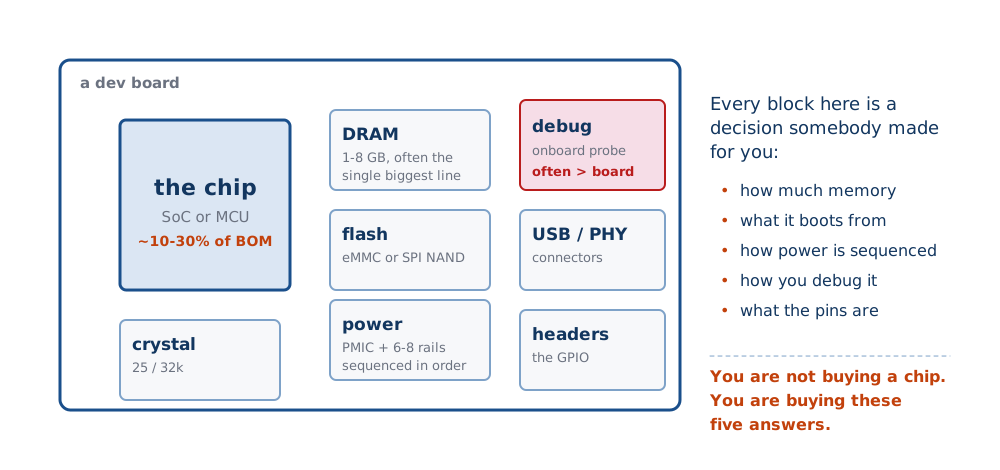
The chip is somewhere between 10% and 30% of the bill of materials. Everything else on that board is a decision somebody made on your behalf.
The Board Is a Reference Design
Almost every vendor publishes the full schematic and layout of their dev board. That is not generosity. It is the instruction manual for the board you are supposed to build instead.
The Efinix Forgix — an RP2354 and a Trion T8 FPGA on one $50 board — says the quiet part out loud:
“Everything on the board is also open source, with the schematics, KiCad project, and example designs all published for developers to explore and build on.”
“The Teensy-compatible footprint means it drops straight into a breadboard for prototyping, then transfers into the final product.”
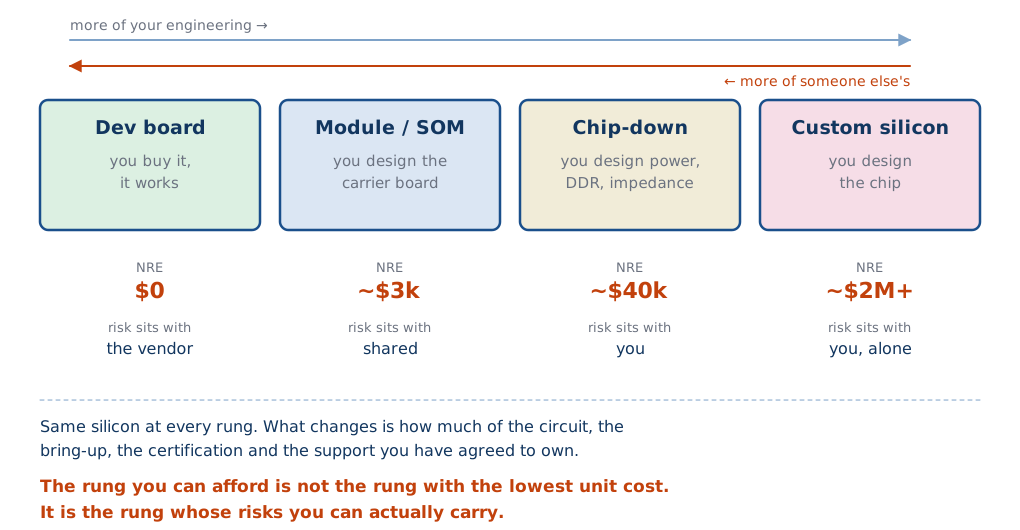
Four Ways to Own the Same Silicon
What Each Rung Costs You
| rung | you design | NRE | what you now own |
|---|---|---|---|
| Dev board | nothing | $0 | nothing |
| Module / SOM | carrier, connectors, power | ~$3k | your board’s yield |
| Chip-down | power sequencing, DDR routing, impedance, EMC | ~$40k | all of it, including EMC |
| Custom silicon | the chip | ~$2M+ | everything, forever |
The NRE column is the one nobody budgets for, and it is not the money — it is the months.
Part II — The Ladder Is Real
The Ladder, Priced
| board | RAM | MMU | what runs on it | price |
|---|---|---|---|---|
| CH32V003 (chip) | 2 KB | no | bare metal | ~$0.10 |
| Raspberry Pi Pico | 264 KB | no | bare metal, MicroPython | $4 |
| STM32F407 board | 192 KB | no | bare metal, FreeRTOS | ~$25 |
| Milk-V Duo S (SG2000) | 512 MB | yes | Linux | from $9.90 |
| VisionFive 2 Lite, 4 GB | 4 GB | yes | Linux | $107.99 |
| Raspberry Pi 5, 8 GB | 8 GB | yes | Linux, a desktop | $200 |
Seven orders of magnitude of memory. Note that the $9.90 board and the $200 board are both Linux.
What the Price Buys: Memory
Memory is not a specification. It is the thing that decides what software exists.
| memory | what you can have |
|---|---|
| 2–8 KB | one loop, no allocator, no stack depth |
| 64–512 KB | an RTOS, a small TCP stack, a display driver |
| 32 MB+ | an MMU, a kernel, a filesystem, a Python interpreter |
| 1 GB+ | a browser, a compiler, a desktop |
The MMU Line
The single biggest discontinuity in the whole ladder is not memory. It is whether there is an MMU.
No MMU
- bare metal, or an RTOS
- you own every cycle
- a pin is yours to time
- failures are timing failures
MMU
- Linux, and everything above it
- the scheduler owns your pin
- a 50 µs deadline is not achievable
- failures are usually timing failures
What the Price Buys: Interfaces
Bit-banging works until it doesn’t. The three regimes:
| interface | how it is done | what it costs you |
|---|---|---|
| I²C, UART, a few MHz SPI | bit-bang it, or a simple peripheral | nothing, it is just code |
| USB, 100M Ethernet, SD card | hard peripheral, or a PIO block | pins, and the pin-mux table |
| PCIe, gigabit, MIPI, DDR | only a hard controller | a different class of chip |
GPIO: More Pins, Less Utility
Pin count goes up as chips get bigger. The utility of each pin goes down.
- 10-cent tier — a pin is a UART, a PWM, a button and a bit-banged bus, all at once
- $25 tier — a pin is either RMII_TXD0 or a GPIO or a timer output
- $200 tier — the header is for management: fan enable, reset, a status LED
Your own board: the SG2000 has four GPIO banks and a pinmux chapter that runs for pages. The Duo S brings out 39 of them.
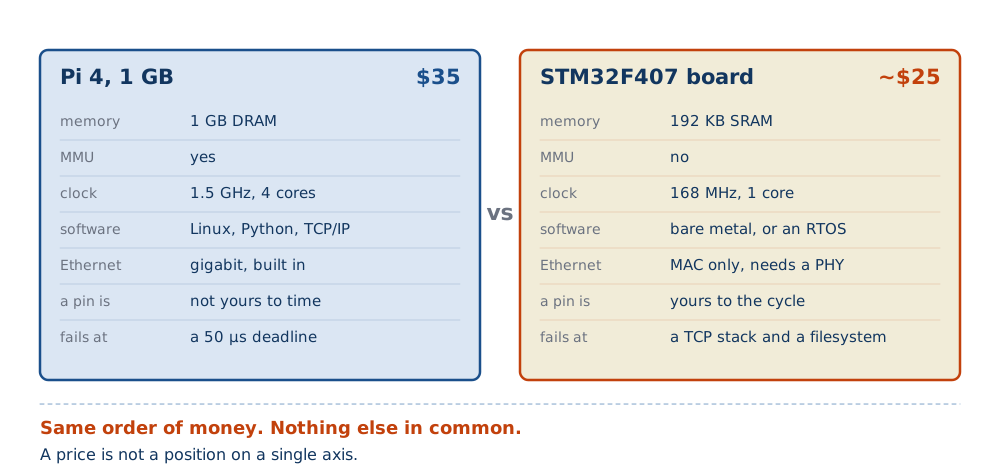
Two Boards, Same Money, Different Universes
Part III — The Economics
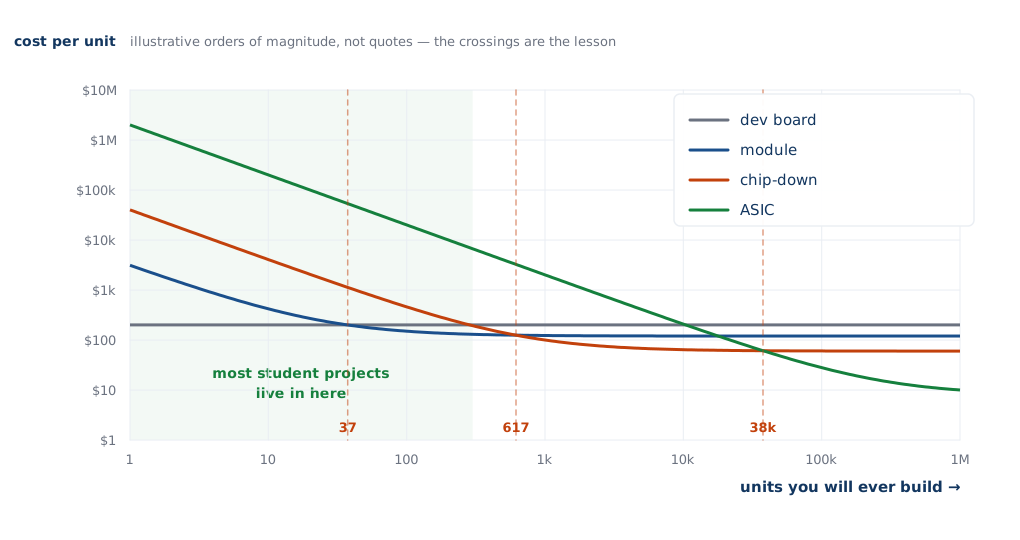
NRE Against Volume
Where the Lines Cross
| you are comparing | break-even | what it means |
|---|---|---|
| dev board → module | ~40 units | below 40, buy the board |
| module → chip-down | ~600 units | below 600, keep the module |
| chip-down → custom silicon | ~40,000 units | below 40k, do not tape out |
Read the middle row again. Six hundred units is the number that decides most hardware startups.
Do the Arithmetic for Your Project
| units | the right answer | why |
|---|---|---|
| 1 — a class project | dev board | NRE is infinite, unit cost is irrelevant |
| 30 — a lab instrument | dev board | $40k NRE over 30 units is $1,300 each |
| 300 — a pilot run | module + carrier | you get your form factor, you keep the hard part |
| 30,000 — a product | chip-down | now the NRE is the cheap part |
The Number Nobody Budgets
NRE is not mostly money. It is mostly time, and the time is spent on things that do not appear in any datasheet:
- power sequencing that is almost right and browns out under load
- DDR routing that works on the bench and fails over temperature
- EMC: the board that radiates, discovered in the compliance lab, six weeks before ship
- the bring-up where nothing boots and you have no reference design to diff against
Part IV — Two Kinds of Dev Board
Advertisement and Product
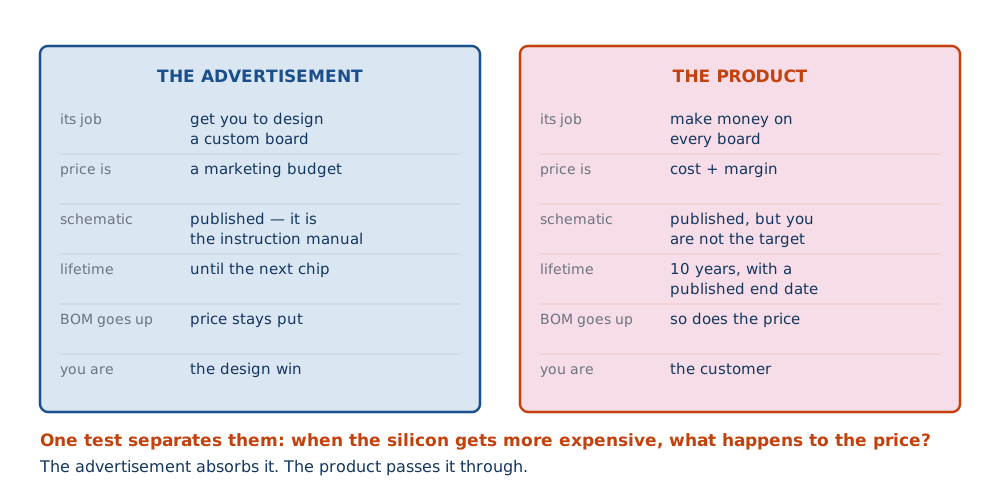
The Advertisement
- priced to move chips, not to make money on boards
- schematic published, because you are meant to copy it
- the onboard debugger often costs more than the board
- refreshed with each chip generation; the old one is discontinued
- “for evaluation purposes” is in the terms, and sometimes on the silkscreen
Its job is to make you stop using it.
The Product
- priced to make money on every board
- a published maximum price, enforced through approved resellers
- a ten-year manufacturing commitment, with a published end-of-life date
- a support contract, and somebody to email
- a Compute Module line, for people who want the silicon without the board
Its job is to keep being available.
The Diagnostic
When the silicon gets more expensive, what happens to the price?
The advertisement
absorbs it. The price does not move, because the price was never a cost.
The product
passes it through. The price moves, because the price is cost plus margin.
You do not have to guess which one you are holding. 2026 is running the experiment for you.
Part V — What a Price Is
The Pi Held $35 for Nine Years
2012: one board, $35. 2013, 2014, 2015, 2016, 2017, 2018, 2019: still $35.
Then in October 2021, Raspberry Pi published a post titled “Supply chain, shortages, and our first-ever price increase.” The 2 GB Pi 4 went from $35 to $45.
That was the tell. A board priced as marketing does not have a first-ever price increase. A board priced as a product does.
Then It Didn’t
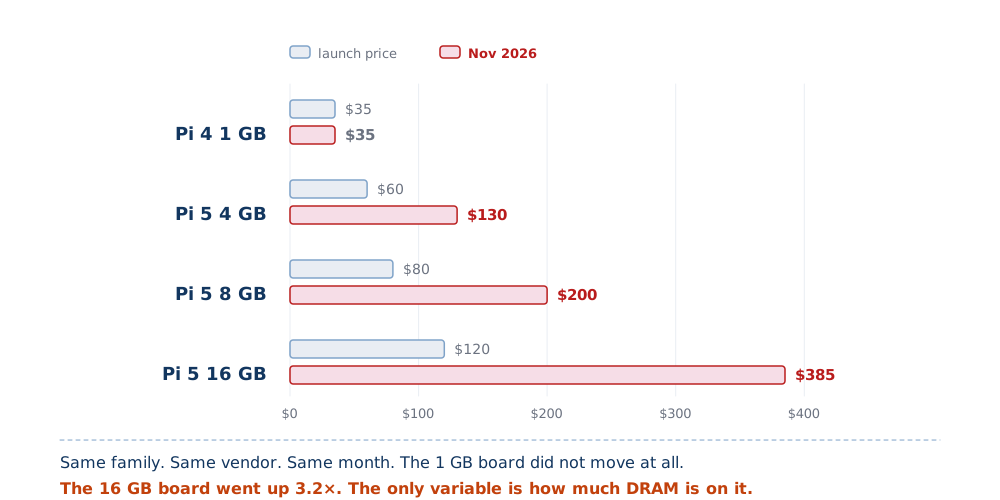
Why: The Price of a Board Is the Price of Its Memory
Raspberry Pi’s own explanation, April 2026 — the LPDDR4 on the Pi 4 and 5 went up sevenfold in one year.
And in the same post, the control group:
“We don’t anticipate any price rises for our classic products, including Raspberry Pi Zero, Zero W and Zero 2 W… These products use older LPDDR2 DRAM, of which we currently hold substantial inventory.”
The Pico is still $4. It has no DRAM at all.
Two Boards, Two Kinds of Claim
| paid | 2026-11-17 |
multiple | |
|---|---|---|---|
| Pi 5, 8 GB | $80 (launch, Oct 2023) | $200 | 2.5× |
| VisionFive 2 Lite, 4 GB | $19.90 (campaign, Aug 2025) | $107.99 | 5.4× |
Both memory-bound. Both went up. They mean completely different things.
Part VI — Where the Ladder Breaks
Four Axes the Ladder Doesn’t Measure
The ladder assumes every board is trading in the same currencies: memory, interfaces, package size, price. Four kinds of device do not.
| the burden moves to | the question changes from | to |
|---|---|---|
| memory physics | how much RAM? | what does it cost to persist a byte? |
| the fabric | what does the firmware do? | what does the hardware do? |
| the operator set | how fast is the CPU? | what can the accelerator compute? |
| qualification | how fast is it? | what failure rate is acceptable? |
Burden in the Memory Physics: FRAM
On the MSP430FR2355, “RAM” and “flash” are the same array.
| flash MCU | FRAM | |
|---|---|---|
| write one word | tens of µs to ms, erase first | one clock cycle (TI SLASEC4D) |
| endurance | ~10⁴–10⁵ cycles | 10¹⁵ cycles |
| write energy | charge pump, high | a fraction |
| retention across power loss | yes, if the write finished | yes, and the write cannot be interrupted |
Burden in the Fabric: Forgix
RP2354 plus an Efinix Trion T8 with 7,384 logic elements, on a $50 board.
The FPGA’s pins are not muxed in the MCU sense. Their function is defined by a bitstream — so the question is not “which peripheral do I assign to this pin” but “what peripheral do I build?”
You pay in
- Verilog
- place-and-route time
- a second toolchain
- a debugging model with no
printf
You get
- a custom protocol, in hardware
- timing that does not care about the OS
- N parallel copies of anything
- a pin that is whatever you said it is
Burden in the Operator Set: The Accelerator
The Hailo-8 does 26 TOPS at 2.5 W over PCIe, with all its memory on-die. It has no DRAM to be short of.
But you cannot program it. You hand it a model and it runs the operations it supports.
You have met this device. It is the TPU on your course board.
Burden in the Qualification: Rad-Hard
A rad-hard part is not a faster or slower part. It is a part whose price is dominated by testing, not by silicon.
- the smallest “true” rad-hard process is 110–150 nm; commercial silicon is 2–3 nm
- so in space, you run years behind on process technology
- the reason is low volume plus years of qualification testing
- and the engineering question becomes: what failure rate is acceptable for this mission?
One Question
Which of these burdens is your project actually equipped to carry?
A team with strong Verilog and no RF test equipment should not take the rad-tolerant path. A team that needs a $20 bill of materials and cannot guarantee a six-month production run should not design around a crowdfunding tier.
The chips are not better or worse. They are different allocations of difficulty.
Part VII — Picking
The Procedure
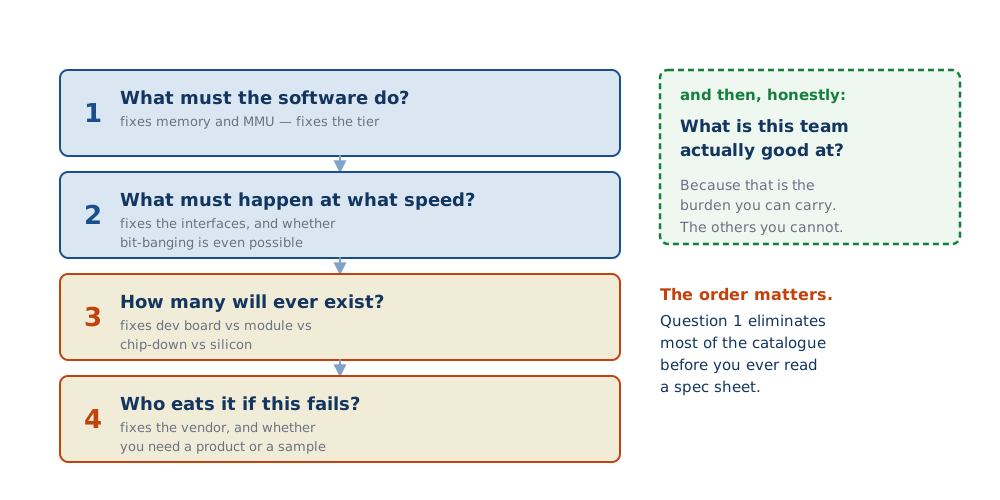
The Question Nobody Asks
Every part in this lecture is a bargain: this difficulty, for that capability.
The only question that matters is whether the difficulty lands somewhere your team can carry it.
- strong Verilog, no RF lab → FPGA, not radio
- strong Linux, no hardware bring-up → Pi, not chip-down
- strong analog, no toolchain → an eval board with a known-good SDK
- three weeks and four people → whatever has the best tutorial
Close
Every board is a bet about where the difficulty should live.
The vendor is betting you will design your own board later. Sometimes you will. Sometimes the board is good enough that you ship it instead — and then the advertisement becomes the product, the price becomes a real price, and it moves when memory does.
Pick the difficulty you can carry. Then check what your board costs today.
Sources
Prices read 2026-11-17. Every figure in this deck is a data point with a timestamp, not a property of the board.
| what | where |
|---|---|
| Pi 5 — $200 / $385 / $130 | Adafruit product page |
| Pi 4, 1 GB — $35 | Raspberry Pi, October 2026 |
| The four increase rounds; LPDDR4 up 7×; LPDDR2 stock | Raspberry Pi news, Oct 2025 – Oct 2026 |
| Pi launch prices — $80 / $120 / $60 | launch announcements, October 2023 |
| More than 70% of sales are industrial | CNN Business, 11 June 2024 |
| Duo S — from $9.90, 512 MB, 39 GPIO | milkv.io/duo-s |
| VisionFive 2 Lite — 436 backers, HK$200,765; $107.99 today | Kickstarter (archived), Amazon |
| Forgix — Trion T8F49, 7,384 LE, $50 | Efinix blog, 27 August 2026 |
| Hailo-8 — 26 TOPS, 2.5 W, memory on-die | hailo.ai |
| FRAM — 10¹⁵ cycles, 1-cycle write, unified map | TI MSP430FR2355, SLASEC4D |
| Rad-hard — 110–150 nm against 2–3 nm | Wikipedia, Radiation hardening |
CS 4250 · Picking a Board — all prices as of 2026-11-17